 Mashrukh Araf
Many business owners assume automation is something to consider only after a company becomes large. In reality, the right time to automate is often before manual work starts slowing your growth.
You do not need hundreds of employees or thousands of customers to benefit from automation. Even a small business can save significant time when repetitive tasks are handled by intelligent workflows.
Here are some signs that your business may be ready.
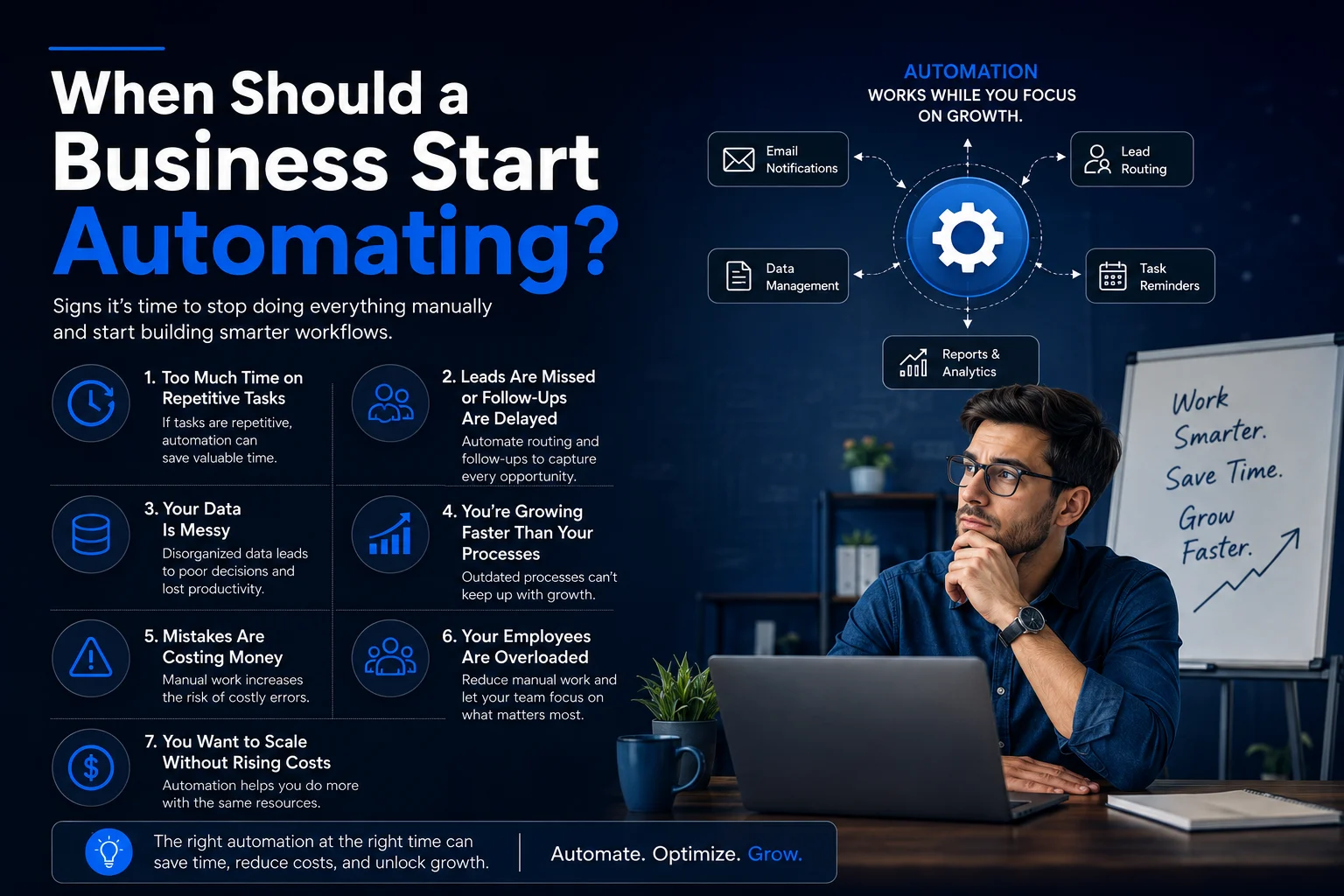
1. Your Team Spends Too Much Time on Repetitive Tasks
If employees regularly copy information between spreadsheets, update CRM records, send the same emails, create routine reports, or enter customer data manually, automation can take these tasks off their plate.
Your team can then spend more time on sales, customer service, strategy, and other work that actually requires human judgment.
2. Leads Are Being Missed or Follow-Ups Are Delayed
A growing number of leads is a good problem to have, until your team cannot respond to them quickly enough.
Automated lead routing can send each lead to the right salesperson, trigger follow-up reminders, and keep customer information organized.
The goal is simple: the right lead reaches the right person at the right time.
3. Your CRM or Business Data Is Becoming Messy
Duplicate records, incomplete customer information, inconsistent data, and outdated spreadsheets can make decision-making difficult.
Automated workflows can help collect, organize, update, and move information between systems with less manual intervention.
4. Your Business Is Growing Faster Than Your Processes
Growth often exposes weaknesses that were easy to ignore when the business was smaller.
A process that worked for 20 customers may become frustrating when you have 200.
Instead of continually adding more manual work, businesses can automate repeatable processes and build systems that scale alongside them.
5. Mistakes Are Starting to Cost Money
Manual work inevitably creates opportunities for human error.
A missed follow-up can mean a lost customer. An incorrect data entry can create operational problems. A forgotten invoice can affect cash flow.
Automation does not eliminate every business mistake, but it can reduce errors in repetitive, rule-based processes.
6. Your Employees Are Overloaded
Automation is not about replacing your team. It is about removing unnecessary work from their workload.
When employees spend less time on repetitive administrative tasks, they can focus on activities where their experience, creativity, and decision-making actually matter.
7. You Want to Scale Without Increasing Costs at the Same Rate
This is one of the biggest reasons to automate.
If every increase in customers requires a proportional increase in manual work and employees, your operating costs can quickly rise.
Well-designed automation allows businesses to handle more work through better processes, helping protect profit margins as they grow.
So, When Is the Right Time?
Start automating when a task is repetitive, predictable, time-consuming, and important enough that mistakes have a cost.
You do not need to automate everything at once. Start with one bottleneck, measure the time and cost it consumes, and improve from there.
At UPNEZ, the focus should be on building intelligent workflows that fit the way a business actually operates, rather than adding automation simply for the sake of technology.
Less repetitive work. Better processes. More room to grow.
