 Mashrukh Araf
Efficiency is the cornerstone of growth, yet for many small and medium enterprises, the journey toward automation often leads to more confusion than clarity. To scale effectively, automation must be treated as a strategic foundation rather than a series of quick fixes.
1. The Automation Trap: Why Most SMEs Build a ‘Spaghetti Stack’
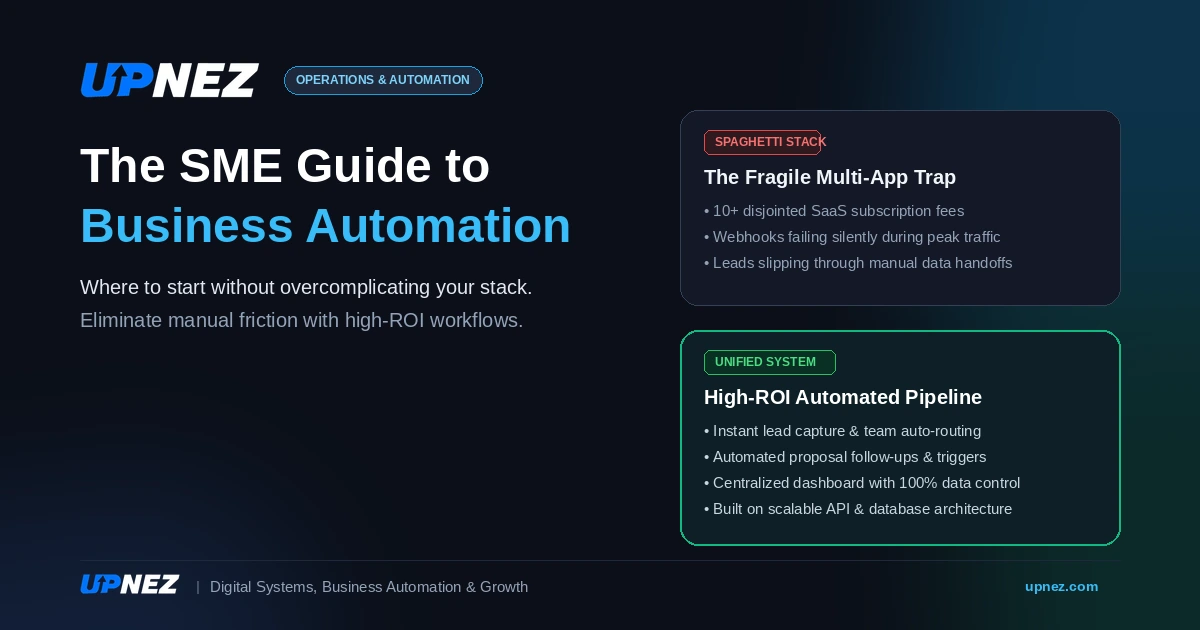
Many SMEs fall into the “Spaghetti Stack” trap: a tangled web of disconnected applications and software tools. This occurs when a business purchases a specific tool to solve a single, isolated problem without considering how it fits into the broader operational ecosystem.
The result is data silos, where information from sales doesn’t reach customer service, and manual work increases as employees are forced to bridge the gaps between non-communicating systems. A unified approach is required to ensure that automation simplifies work rather than adding another layer of management.
2. The 3 Core Rules Before Automating Any Process
Before investing in new software or building a workflow, adhere to these three fundamental principles to ensure success:
- Simplify Before You Automate: Never automate a broken or inefficient process. If a workflow is convoluted when performed manually, automation will only accelerate the errors. Streamline the steps first.
- Define Trigger and Action: Every automation needs a clear “If This, Then That” logic. Clearly identify what event starts the process (the Trigger) and exactly what needs to happen next (the Action).
- Prioritize Data Integrity: Automation is only as good as the data powering it. Ensure your contact records, deal stages, and customer information are clean and standardized before syncing them across platforms.
3. The 3 Highest-ROI Automations Every SME Should Start With
If you are looking for the most significant impact with the least amount of technical debt, focus on these three areas:
Lead Routing
Instead of manually assigning new inquiries, use automation to route leads instantly based on pre-defined criteria such as territory, industry, or company size. This ensures the right salesperson gets the lead while it is still fresh, significantly increasing conversion rates.
Deal Follow-up
Sales momentum is often lost in the “follow-up gap.” Automated deal follow-up triggers reminders or personalized email sequences when a deal has been stagnant in a specific pipeline stage for a set number of days. This keeps your brand top-of-mind without manual intervention.
Post-Sale Onboarding
The transition from “Closed-Won” to an active customer should be seamless. Automate the hand-off by triggering welcome emails, internal task assignments for project managers, and the creation of client folders the moment a contract is signed.
| Automation Type | Key Trigger | Primary Benefit |
|---|---|---|
| Lead Routing | New Form Submission | Reduced Lead Response Time |
| Deal Follow-up | Stage Stagnation (>3 Days) | Increased Pipeline Velocity |
| Post-Sale Onboarding | Deal Marked as Won | Consistent Customer Experience |
4. What You Should NOT Automate
While automation is powerful, certain “high-touch” human tasks should remain manual to preserve the quality of your business relationships:
- Complex Negotiations: The nuance and empathy required to close a high-stakes deal cannot be replicated by a machine.
- Strategic Decision-Making: Automation can provide the data, but humans must interpret the “why” and determine the long-term direction.
- Sensitive Customer Support: Issues requiring deep empathy or those involving significant conflict are best handled by a trained professional who can read between the lines.
5. The 4-Step Implementation Roadmap: From Spreadsheets to Unified Systems
Transitioning from manual tracking to a unified automated system is a journey. Follow this roadmap to maintain stability:
- The Audit: List every manual task performed daily. Identify which tasks are repetitive and time-consuming.
- The Workflow Map: Draw out the ideal path for a customer from lead to loyal advocate. Identify where the gaps and bottlenecks exist.
- The Integration Phase: Move away from isolated spreadsheets and select a central hub (CRM) that allows for native integrations with your existing tools.
- The Optimization Loop: Launch your first automation, monitor the results for 30 days, and iterate based on feedback from the team using the system.
6. Conclusion & Strategic Next Steps with UPNEZ
Automation is not about replacing your team; it is about liberating them from the mundane so they can focus on high-value work. By avoiding the “Spaghetti Stack” and focusing on high-ROI workflows like lead routing and onboarding, your SME can build a scalable foundation for the future.
Ready to transition from fragmented spreadsheets to a unified, high-performance system? UPNEZ specializes in helping SMEs navigate the complexities of business automation. We don’t just give you tools; we build the strategy that makes them work for you.
Contact at UPNEZ today to begin your automation audit.
