 Mashrukh Araf
The way businesses think about websites is changing.
For years, a business website mainly had one job: present information, build credibility, and help customers get in touch.
That model is starting to change.
By 2027, businesses will increasingly expect their websites to do more than display information. Websites will need to understand visitors, automate processes, personalize experiences, connect with business systems, and work alongside AI.
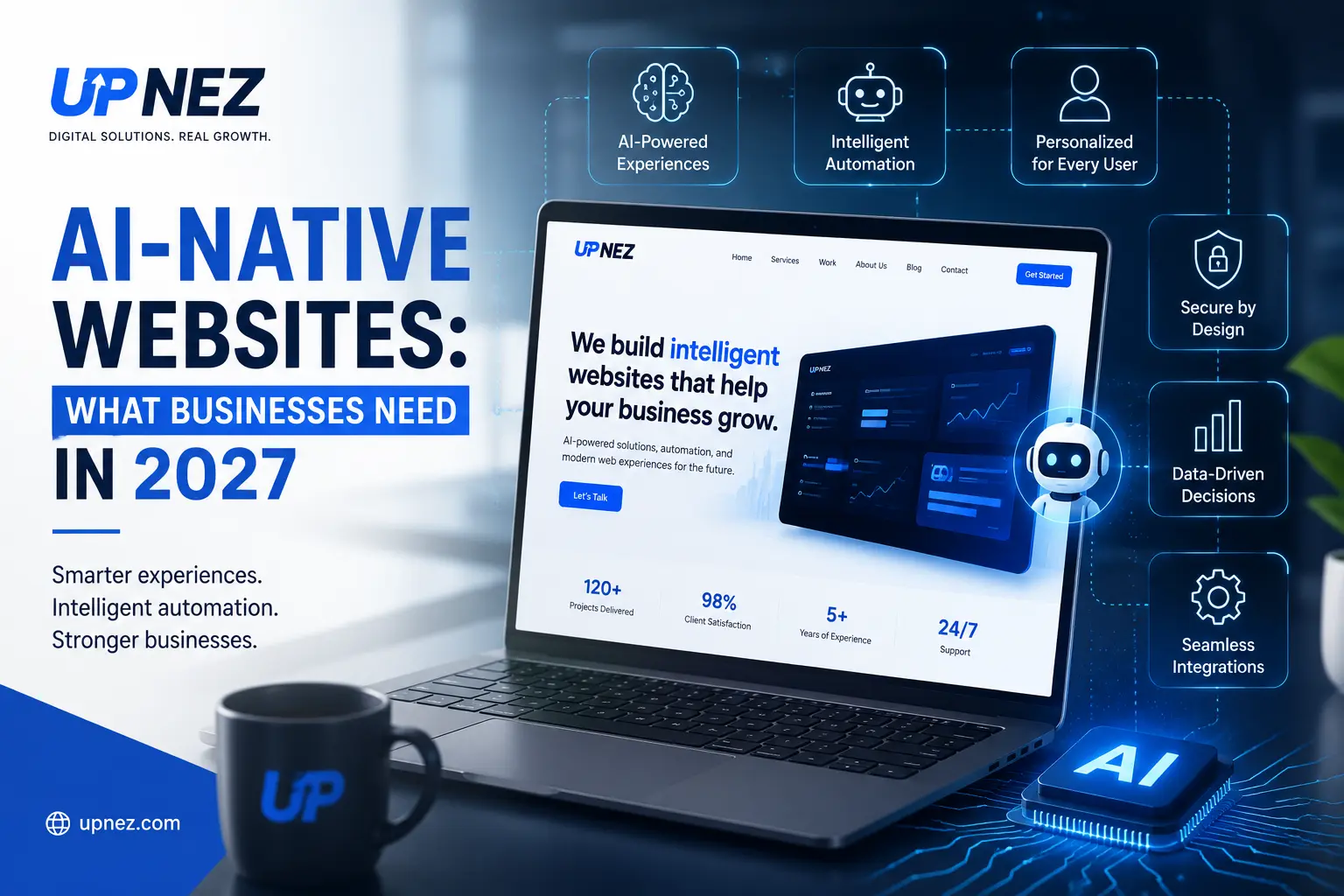
This shift is leading to a new concept: AI-native websites.
What is an AI-native website?
An AI-native website is not simply a traditional website with a chatbot added to it.
It is a website designed from the beginning to use AI as part of the overall business experience.
Depending on the business, this can include:
- AI-powered customer support
- Personalized content and recommendations
- Automated lead qualification
- Intelligent search
- AI-assisted sales processes
- Automated appointment or inquiry handling
- Business workflow automation
- Data-driven personalization
- AI-powered analytics
The goal is simple: instead of making customers navigate a website and figure everything out themselves, the website can actively help them reach the right outcome.
Why AI is becoming important for business websites
AI adoption among small and medium-sized businesses is moving beyond experimentation.
IDC reports that SMBs are increasingly focusing on practical AI applications that can deliver measurable business value, particularly in areas such as customer engagement, marketing and automation.
That changes the role of a website.
A website is no longer just a digital brochure.
It can become part of the company’s operational system.
For example, imagine a service business receiving 100 inquiries every day.
Instead of having employees manually answer every basic question, an AI-enabled website could:
- Understand what the visitor needs.
- Answer common questions.
- Collect the required information.
- Identify qualified leads.
- Send the information to the appropriate team.
- Schedule a meeting when necessary.
The website becomes an active business tool rather than a passive information source.
5 things businesses should expect from websites in 2027
1. Smarter customer experiences
Customers increasingly expect immediate and relevant answers.
AI can help websites understand intent rather than simply matching keywords.
A visitor looking for a particular service could receive relevant information, recommendations, pricing guidance or next steps based on what they are actually trying to accomplish.
2. Automation beyond chatbots
Chatbots were only the beginning.
The next stage is connecting AI with actual business workflows.
An AI system could potentially move from:
Question → Answer
to:
Question → Understand → Decide → Execute
That could mean creating a lead, sending information, scheduling an appointment or initiating another internal workflow.
The growth of agentic and multi-agent AI is one of the major technology directions being tracked for 2026 and beyond.
3. Personalization
Two visitors do not necessarily have the same needs.
An AI-native website can potentially use available context to provide more relevant experiences.
For an e-commerce business, this could mean better product recommendations.
For a service company, it could mean guiding different types of customers toward different services.
For a B2B company, it could mean presenting information based on the visitor’s industry or business requirements.
Personalization can make the website feel less like a static page and more like an intelligent digital assistant.
4. Security becomes even more important
More intelligence also means more responsibility.
As businesses connect AI systems with customer information, internal tools and business processes, security cannot be treated as an afterthought.
Gartner identifies AI security platforms and preemptive cybersecurity among the important cybersecurity directions for 2026. The World Economic Forum also highlights the growing interaction between AI adoption and cybersecurity risks.
For businesses, this means future websites need to consider:
- Data protection
- Secure authentication
- Access control
- API security
- AI security
- Privacy
- Monitoring
- Regular security updates
5. The technology stack will matter more
An AI-native website does not necessarily mean replacing everything with AI.
The foundation still matters.
A scalable website may combine technologies such as:
Frontend → React / modern JavaScript
Backend → Laravel / PHP / Node.js
Database → MySQL / PostgreSQL
AI → LLM APIs / AI agents / custom AI services
Infrastructure → Cloud hosting / APIs / automation
The important part is not using the trendiest technology.
The important part is building an architecture that can evolve as the business evolves.
So, does every business need an AI website?
No.
AI should not be added simply because it is popular.
A business should first identify where AI can actually create value.
For some businesses, a fast and well-designed website with excellent SEO may provide more value than an expensive AI system.
For others, AI-powered customer support, lead qualification or workflow automation could significantly improve efficiency.
The right question is therefore not:
“Do we need AI?”
The better question is:
“Where can AI create measurable value for our customers and our business?”
The website of 2027 will be more than a website
The next generation of business websites will increasingly connect design, software, data, automation and artificial intelligence.
The businesses that benefit most will not necessarily be the ones that add the most AI features.
They will be the ones that use technology to solve real customer and operational problems.
At UPNEZ, we believe websites should be built with that future in mind.
Not just something that looks good today.
Something that can grow, integrate and evolve with the business.
Your website should not just represent your business. It should help run it.
