 Mashrukh Araf
If you operate an e-commerce brand, retail store, or service business in Bangladesh, you have almost certainly hit the “Boost Post” button on Facebook.
You are not alone. Across Bangladesh’s rapidly maturing digital commerce ecosystem, over 90% of small-and-medium enterprises (SMEs) burn through their marketing capital using direct post boosts.
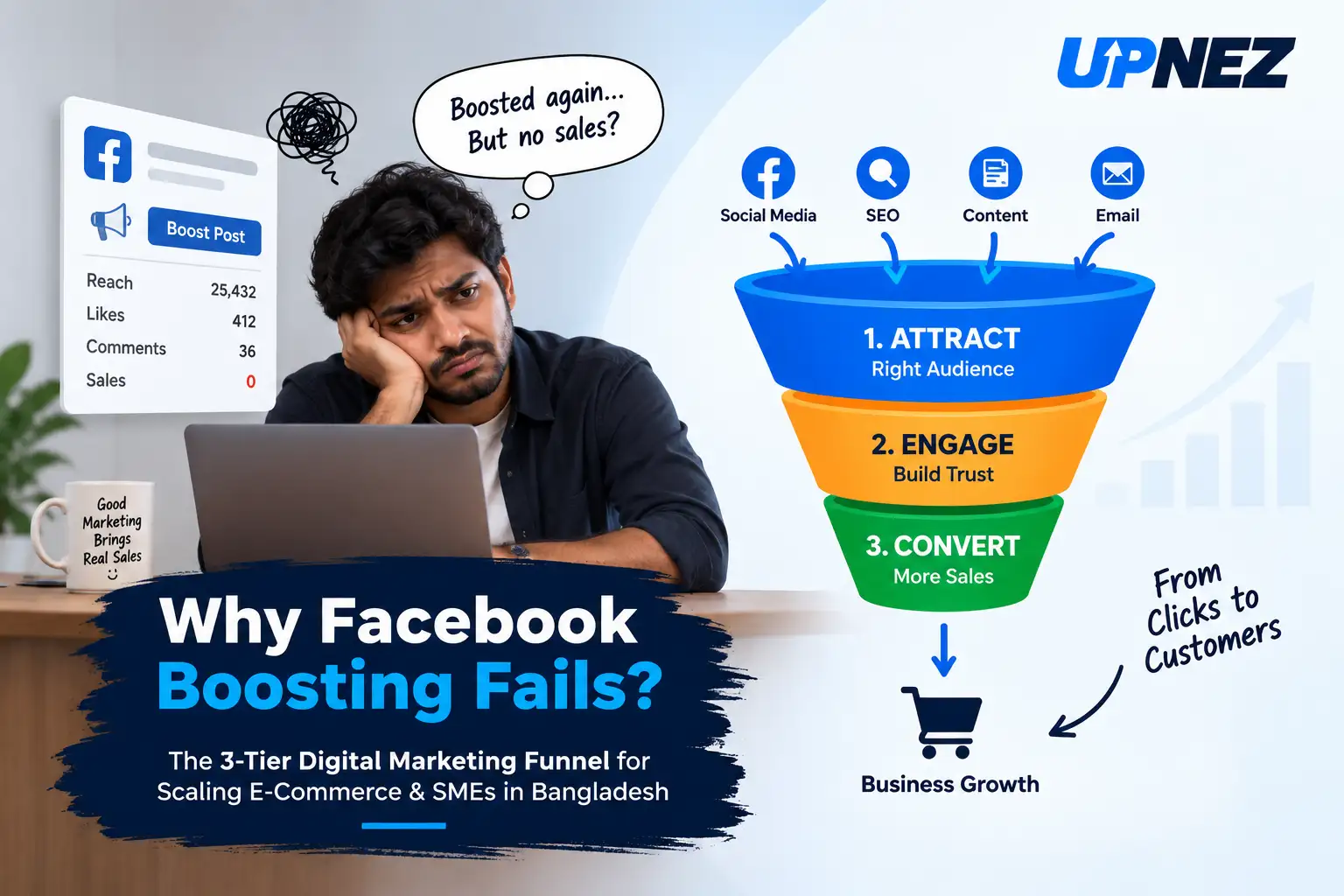
The issue is not that digital advertising is broken. The issue is that “boosting” is not a marketing strategy—it is an algorithmic donation to Meta.
To scale a business sustainably in 2026, you must transition from ad-hoc boosting to a structured, intent-driven 3-Tier Performance Funnel supported by high-speed web infrastructure and automated CRM workflows.
1. The “Boost Button” Trap: Why Post Boosting Destroys Your Ad Spend
When you click the blue “Boost Post” button on Facebook or Instagram, Meta’s algorithm optimizes for one primary metric: cheap engagement.
[Boost Button] ➔ Optimizes for Likes/Comments ➔ Vanity Metrics ➔ Zero Purchase Intent
Meta’s auction system categorizes users based on historical behavior:
- Engagers: People who habitually like, react, and comment on posts.
- Clickers: People who click on links to read articles or view pictures.
- Buyers: High-intent consumers who frequently complete checkouts, enter payment details, and purchase online.
When you boost a post, Meta shows your creative to the cheapest segment: Engagers. You receive hundreds of vanity reactions, but very few qualified buyers ever see your offer.
The Missing Technical Tracking (Browser Pixel vs. Server CAPI)
Modern ad platforms face major tracking barriers due to browser privacy restrictions, cookie deprecation, and ad blockers. Basic pixel tags placed on standard website templates routinely lose 20% to 30% of conversion data.
Without server-side tracking, such as the Meta Conversions API (CAPI), Meta never receives confirmation of who completed a purchase. As a result, the algorithm cannot optimize for higher-value buyers.
2. The Solution: The UPNEZ 3-Tier Ad Funnel Architecture
Rather than treating every consumer the same, high-growth brands structure their customer acquisition into three distinct stages: Awareness, High-Intent Acquisition, and Automated Retargeting.
Tier 1: Authority & Awareness (Top of Funnel)
- Objective: Introduce the brand and address specific pain points.
- Format: 15–30 second short-form video Reels or founder case breakdowns.
- Targeting: Broad demographic targeting in urban commercial hubs (e.g., Dhaka, Chittagong, Sylhet).
- Core Message: Educate the market. Highlight what makes your product unique without aggressively pushing an immediate sale.
Tier 2: Intent-Mapped Traffic & Lead Generation (Middle of Funnel)
- Objective: Drive qualified buyers to dedicated, single-focus landing pages.
- Format: High-contrast product carousels or problem-solving video demonstrations.
- Crucial Rule: Never send ad traffic to a generic homepage. If your ad highlights a specific product line or business consultation service, the user must land on a page dedicated exclusively to that solution.
- Targeting: Custom lookalike audiences and interest-segmented groups.
Tier 3: Automated Retargeting (Bottom of Funnel)
Coordinated cross-platform retargeting lifts average conversion rates by up to 48% compared to single-touch campaigns.
- Objective: Close buyers who visited the website or added items to their cart but did not complete the transaction.
- Format: Dynamic Product Ads (DPA), customer video reviews, limited-time delivery incentives, and FAQ breakdown creatives.
3. The Conversion Killer: Why Slow Websites Leak Ad Revenue
You can run the most sophisticated Meta campaigns in the country, but if your website takes longer than 3 seconds to load on a mobile 4G connection, over 50% of your paid traffic bounces before seeing your headline.
Why Bloated CMS Templates Fail
Many local businesses build their web presence using off-the-shelf templates overloaded with 40+ third-party plugins. Each plugin injects render-blocking JavaScript and CSS stylesheets, crippling mobile responsiveness.
At UPNEZ Web Systems, our engineering protocol standardizes custom builds on lightweight, hardened frameworks like Laravel. This architecture delivers:
- Sub-3-Second Global Load Times: Passing all Core Web Vitals benchmarks.
- Zero Plugin Conflicts: Eliminating security vulnerabilities and unexpected crashes during high-traffic festival sales.
- Edge-Cached Security: Cloudflare edge-routing to maintain consistent performance across desktop and mobile networks.
Frictionless Checkout with Instant MFS (bKash / Nagad)
In Bangladesh, complicated checkouts that require customers to manually create accounts, remember passwords, and enter 15 fields of information lead to catastrophic cart abandonment.
A high-converting local e-commerce build requires:
- Single-Screen Guest Checkout: Name, phone number, and delivery district—nothing more.
- Direct MFS API Integration: One-click tokenized payment flows via bKash and Nagad alongside reliable Cash on Delivery (COD) options.
4. Speed-to-Lead: Instant CRM & WhatsApp Automation
In the service and B2B sectors—such as real estate, corporate consulting, or custom manufacturing—leads are won or lost in the first 5 minutes.
Research shows that sales teams that contact an inbound lead within five minutes are 21 times more likely to qualify that prospect than those who wait just 30 minutes.
If your sales process relies on manual spreadsheet entry, leads sit unattended for hours. By integrating automated CRM routing with Click-to-WhatsApp (CTWA) triggers:
- Inquiries are instantly tagged by interest and budget tier.
- Prospects immediately receive automated welcome materials or calendar booking links.
- Sales representatives receive instant mobile alerts to follow up while buyer intent is at its peak.
5. Summary Checklist: How to Upgrade Your Growth Strategy
| Old Approach (The Boost Trap) | Modern Growth Architecture (UPNEZ Standard) |
|---|---|
| Clicking “Boost Post” for vanity likes | Structured 3-Tier Meta & Google Ad Funnels |
| Relying on client-side browser cookies | Server-Side Meta CAPI & First-Party Data |
| Directing traffic to slow, generic homepages | Sub-3s intent-mapped single-focus landing pages |
| 5-step checkout with mandatory account creation | Single-screen express checkout with automated bKash/Nagad APIs |
| Manual lead logging in paper/spreadsheets | Automated CRM pipelines with instant WhatsApp triggers |
Frequently Asked Questions (FAQ)
1. Is post boosting ever recommended for a business?
Post boosting can serve a purpose if your sole goal is quick social validation or promoting a non-commercial community announcement. However, for e-commerce sales, B2B client acquisition, or lead generation, running structured campaigns inside Meta Ads Manager is strictly superior.
2. How much should an SME spend on digital marketing in Bangladesh?
Rather than arbitrary spending, determine your budget using unit economics. A healthy benchmark is to ensure your Customer Lifetime Value (LTV) is at least 3 times your Customer Acquisition Cost (CAC). Starting with a structured $5–$15 daily budget across testing tiers allows you to validate winning creatives before scaling.
3. What technical benchmarks should my website hit for ad campaigns?
Your site must maintain a mobile load time under 3 seconds, achieve passing Core Web Vitals scores (especially Interaction to Next Paint – INP), and maintain clean, structured Schema.org markup (LocalBusiness and Product).
Transform Your Digital Marketing into a Predictable Growth Engine
Digital marketing should never feel like a gamble. When your advertising campaigns, high-performance web systems, and lead automation pipelines operate as a unified engine, customer acquisition becomes consistent and measurable.
Is your business burning ad spend on flat boosts?
Explore our systemized frameworks at UPNEZ or contact our consulting team to audit your digital marketing, web infrastructure, and sales pipelines today.
