 Mashrukh Araf
Every founder, marketing director, and e-commerce operator faces the same recurring dilemma when allocating paid acquisition capital:
“Should we invest our ad budget into Facebook Ads (Meta) or Google Ads?”
Ask ten different marketers and you will receive conflicting answers. Some insist that Google Ads is king because it captures people actively searching to buy right now. Others swear by Meta Ads because of its unmatched visual discovery, hyper-focused lifestyle targeting, and cheaper impression costs.
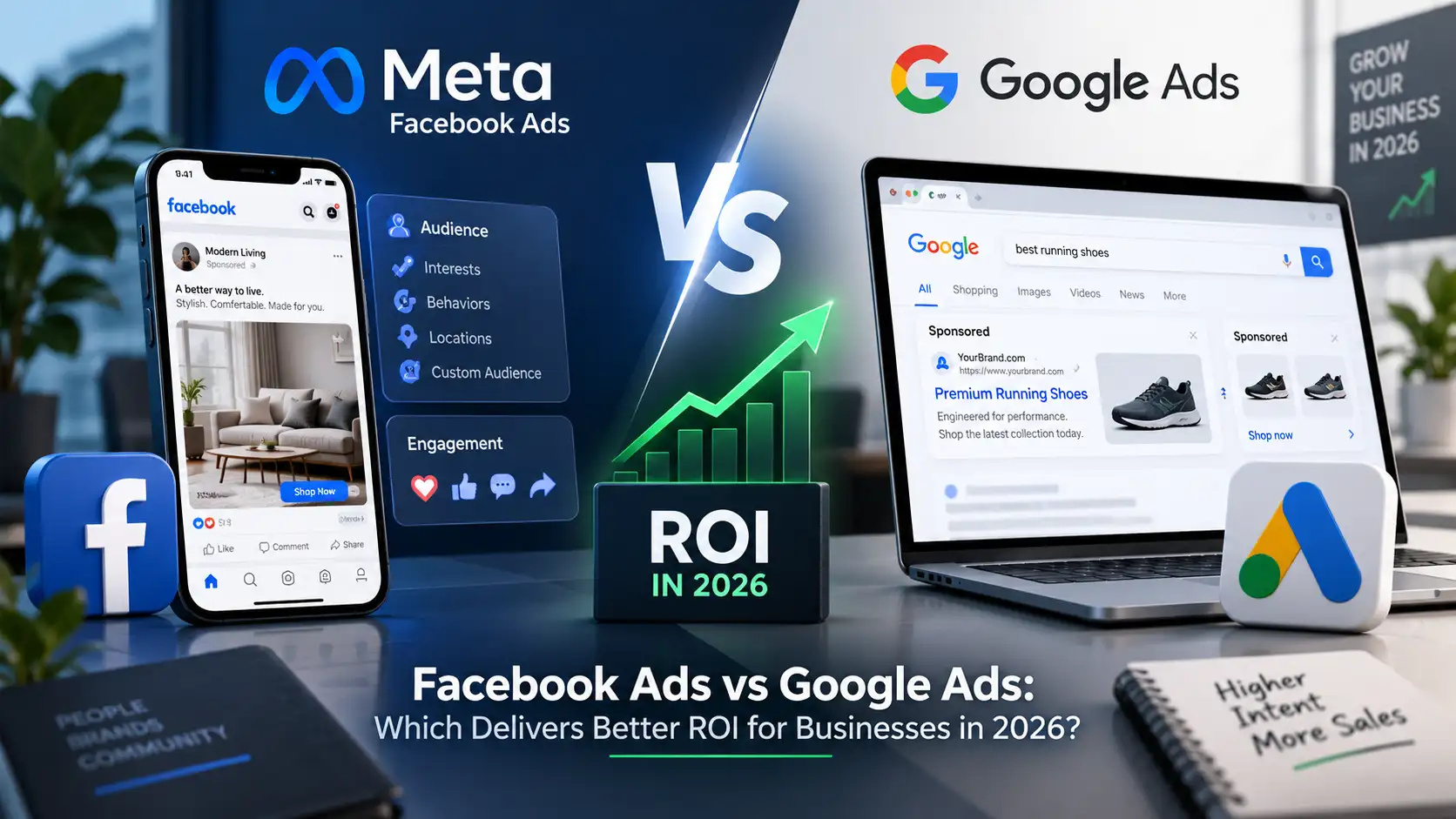
In 2026, the question is no longer about which platform is “better” in isolation. It is about understanding the fundamental psychological difference between Demand Harvesting and Demand Generation—and knowing how to build a cohesive advertising engine that scales your business profitably.
1. The Fundamental Difference: Demand Generation vs. Demand Harvesting
To choose the right advertising channel, you must first understand how consumers behave on each platform.
Google Ads: The Demand Harvester (Active Intent)
Google is an intent-driven search engine. When a user opens Google, they already have a specific problem or purchase desire in mind.
- “Best custom web development agency in Bangladesh”
- “Buy premium leather formal shoes online”
- “Emergency commercial AC repair services”
Google Ads allows you to place your business directly in front of buyers at the exact moment of commercial consideration. You do not need to convince them that they have a problem; they are actively seeking a solution. This is known as Demand Harvesting.
Facebook Ads (Meta): The Demand Generator (Visual Discovery)
Nobody logs into Facebook or Instagram with the explicit intention of buying a product or hiring an agency. Users visit Meta platforms to check updates, watch Reels, and connect with their social circle.
Your job on Meta is to interrupt their scroll with a high-impact creative, a compelling hook, and a solution they did not know they needed. Meta leverages demographic, interest, and machine-learning behavioral patterns to introduce your brand to potential buyers before they ever search for you. This is known as Demand Generation.
2. Performance Breakdown: Meta Ads vs. Google Ads
| Evaluation Metric | Google Ads (Search & Shopping) | Facebook Ads (Meta / Instagram) |
|---|---|---|
| Primary Mechanism | Pull Marketing (Users search for you) | Push Marketing (You find the user) |
| Purchase Intent Level | Very High (Active, solution-seeking intent) | Medium to High (Passive browsing intent) |
| Cost Per Click (CPC) | Moderate to High (Competitive bid auctions) | Low to Moderate (Creative-dependent) |
| Ad Creative Dependency | High relevance on Copy, Keywords & Relevance | Critical relevance on Video, Visuals & Hooks |
| Best Suited For | High-intent products, urgent needs & B2B search | Visual D2C e-commerce, lifestyle & brand discovery |
3. When to Choose Google Ads
Google Ads is unmatched when customer demand already exists and search volume is established.
1. Urgent or High-Intent Problem Solving
If someone’s server crashes, their roof leaks, or they need corporate legal counsel, they do not browse Instagram hoping for an ad—they search Google immediately. For service companies, emergency contractors, and high-ticket B2B providers, Google Search Ads captures customers with immediate urgency.
2. E-Commerce with High Product Search Volume
Through Google Shopping and Performance Max (PMax) campaigns, e-commerce stores can display high-resolution product photography, live pricing, and verified customer ratings directly at the top of Google search results.
4. When to Choose Facebook & Instagram Ads
Meta Ads dominates when your product relies on visual appeal, emotion, or innovative problem-solving that people are not yet searching for.
1. Visual Products & Lifestyle D2C Brands
Fashion apparel, footwear, home decor, luxury accessories, and consumer packaged goods thrive on Meta. A captivating 15-second Reel demonstrating how a product fits or solves a daily frustration triggers spontaneous purchases that traditional search ads cannot replicate.
2. New Innovations with Low Search Volume
If you have built a novel SaaS product, a specialized consulting framework, or an innovative gadget, nobody is searching for your brand name on Google because they do not know it exists. Meta Ads allows you to build brand recognition from scratch.
5. The Winning Approach: The UPNEZ Hybrid Funnel Strategy
At UPNEZ, we do not view Meta and Google as competitors. When scaling fast-growing brands, treating them as complementary halves of a unified growth engine delivers the highest return on ad spend (ROAS).
Meta generates initial brand desire ➔ Google captures active search intent ➔ Both retarget unconverted traffic.
How the Hybrid Architecture Operates:
- Top-of-Funnel (Meta Discovery): Run short-form video ads on Instagram and Facebook introducing your brand’s unique value proposition.
- Middle-of-Funnel (Google Search Safety Net): Prospective customers who view your Meta ad will often open Google later and search your brand name or category. Bidding on branded and high-intent search terms ensures competitors do not steal your traffic.
- Bottom-of-Funnel (Cross-Platform Retargeting): Users who viewed your landing page but abandoned checkout are retargeted across both platforms—displaying dynamic product cards on Facebook and review incentives on Google Display and YouTube.
6. Technical Execution: Why Your Website Speed Dictates Ad Success
Whether you choose Google Ads, Facebook Ads, or a hybrid strategy, your ad budget is only as effective as the post-click experience. If your website takes longer than 3 seconds to load, more than 50% of your paid traffic bounces before seeing your headline.
High-converting paid advertising requires:
- Sub-3-Second Load Speeds: Custom, lightweight engineering (such as Laravel) that eliminates render-blocking CMS plugin bloat.
- Server-Side Tracking: Clean integration of Meta Conversions API (CAPI) and Google Tag Manager Server-Side to capture 100% of conversion data.
- Frictionless Local Checkout: One-click local MFS integration (such as bKash and Nagad) alongside express guest checkout forms.
Frequently Asked Questions (FAQ)
1. Which is cheaper: Facebook Ads or Google Ads?
Facebook Ads generally offers a lower Cost Per Click (CPC) and lower impression costs (CPM) because it relies on visual discovery. Google Ads typically has a higher CPC, but those clicks often carry higher immediate purchase intent because users are actively searching for specific solutions.
2. Can small businesses run both Facebook and Google Ads simultaneously?
Yes. The most profitable strategy for growing brands is a hybrid model: use Meta Ads for top-of-funnel brand awareness and visual discovery, then capture active buyer intent and high-ticket queries using Google Search and Google Shopping.
3. Which platform works better for B2B lead generation?
For urgent, high-ticket problem solving (e.g., software engineering, industrial manufacturing, corporate legal services), Google Search Ads often yields faster inbound leads. However, Meta Ads paired with automated CRM routing and lead magnets excels at building long-term executive pipeline authority.
Stop Guessing Your Paid Advertising Budget
Whether your business needs hyper-targeted Meta ad funnels, high-intent Google Search campaigns, or an integrated hybrid growth architecture, our team engineers campaigns backed by real data, sub-3s web systems, and automated pipelines.
Ready to turn advertising into a predictable profit engine?
Explore our growth frameworks at UPNEZ or schedule a performance audit with our consulting team today.
